India is the world's second-largest QR code scanning market, recording over 1.1 million tracked scans in 2022 — a figure that has grown dramatically since. From UPI payments at a chai stall in Nagpur to digital visiting cards at a tech conference in Hyderabad, QR codes have become a foundational layer of how India does business.
But most professionals and business owners in India know only one or two types of QR code — usually the UPI payment code and, increasingly, the visiting card code. According to NTT DATA Payment Services India's 2026 QR code guide, the main types of QR codes include static QR codes, dynamic QR codes, URL QR codes, vCard QR codes, UPI payment QR codes, iFi QR codes, social media QR codes, WhatsApp QR codes, and location QR codes — each one built for a completely different job.
Understanding which type to use, and when, is the difference between a QR code that works hard for your business and one that just fills space on a card or banner.
This guide explains every major QR code type, what it does, and exactly where Indian professionals and businesses should be using it in 2026.
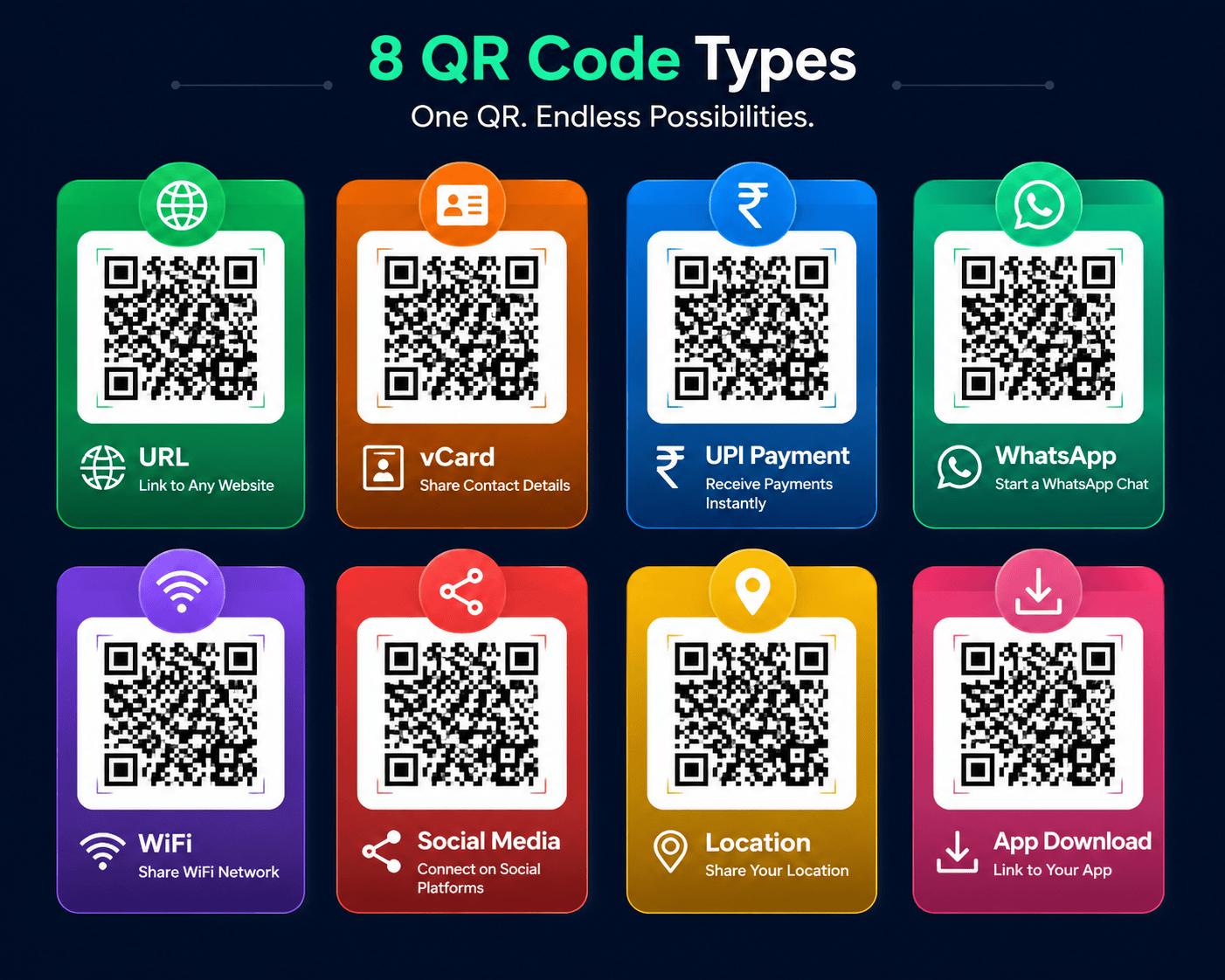
Type 1: URL QR Code
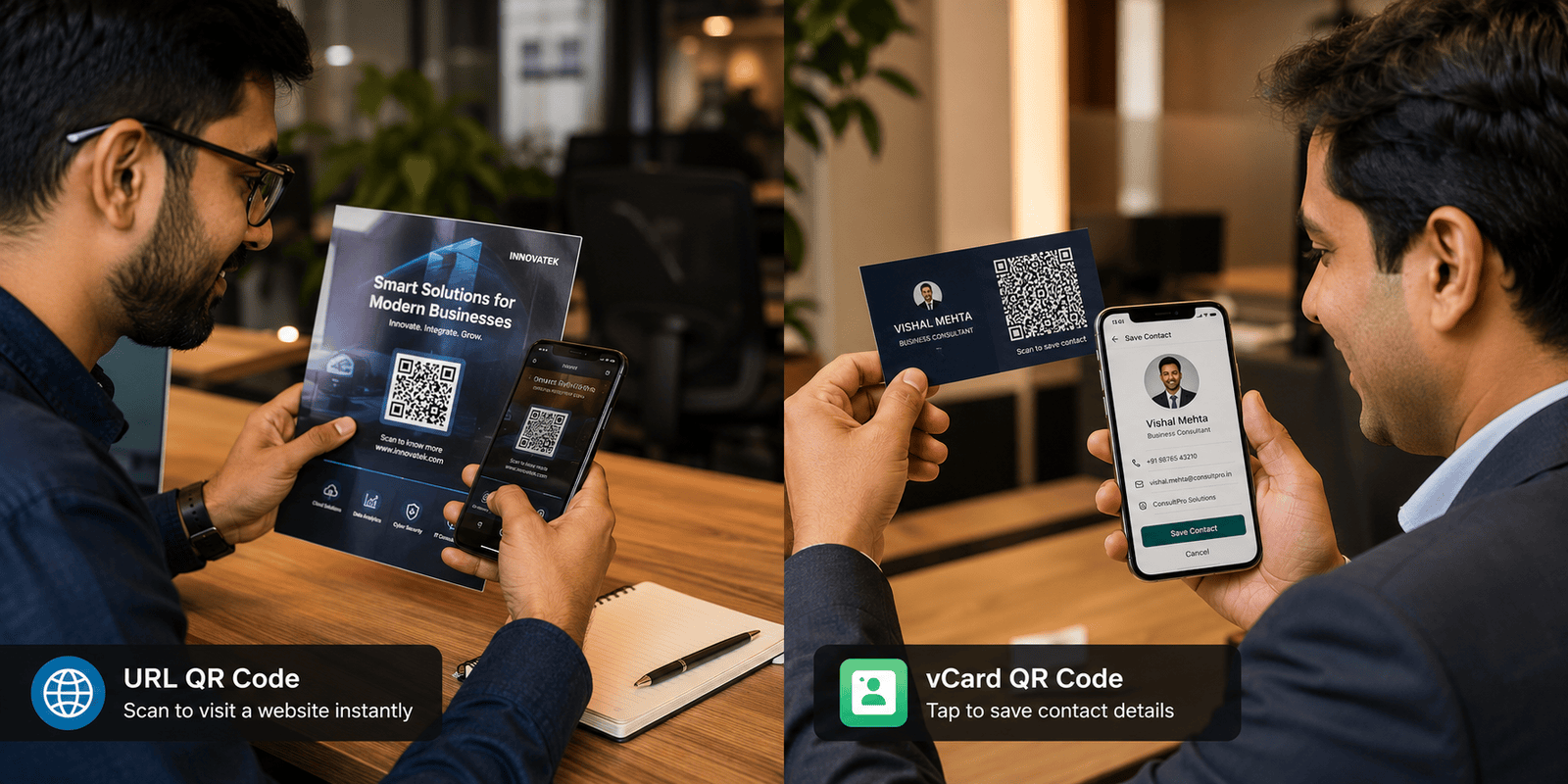
What it does: Encodes any web link — your website, landing page, blog post, product catalogue, or booking page. When scanned, it opens that link directly in the phone's browser.
Why it's the most versatile type: According to Supercode's 2026 QR code types guide, URL QR codes are by far the most common type, accounting for the large majority of QR codes deployed in marketing, packaging, and advertising globally. Any URL can be encoded, and when created as a dynamic code, the destination can be changed at any time without reprinting.
Best use cases in India:
- On visiting cards: Link to your digital profile, portfolio, or ConnectVith.Me page instead of printing a long URL
- On product packaging: Link to a product demo video, instruction manual, or customer support page
- In print advertising: Newspaper ads, brochures, banners, and hoardings — turn any printed surface into a digital gateway
- At events: Exhibitor tables, standees, and name badges linked to a landing page or lead capture form
- In email signatures: A URL QR code in your email signature lets mobile readers visit your website with one scan instead of typing
Static or dynamic? Always dynamic for business use — so you can update the destination if your website changes, and track how many people are scanning from each placement.
Type 2: vCard QR Code
What it does: Encodes your complete contact information — name, phone number, email, company, designation, and website — in a standard format (vCard) that smartphones can import directly into their contacts app with a single tap.
Why it matters for Indian professionals: According to Supercode's guide on practical QR code uses, a vCard QR code encodes your full contact profile in a format that phones can import directly to the contacts app with a single scan — no manual data entry, no transcription errors, no lost business cards at the bottom of a bag.
Best use cases in India:
- On visiting cards: The most direct upgrade from a paper card — one scan and your complete contact is saved forever
- On your phone's lock screen: At a conference, show your screen and let the other person scan. Paperless, always current
- On office signage or reception desks: Clients who visit your office can scan and save your details without asking for a card
Static or dynamic? Dynamic — so you can update your phone number, email, or designation without reprinting. A dynamic vCard QR code on your ConnectVith.Me visiting card stays accurate for the life of the card, regardless of how many times your details change.
ConnectVith.Me connection: Every ConnectVith.Me QR visiting card is built around a dynamic vCard profile — but goes further than a standard vCard by adding WhatsApp buttons, portfolio links, lead capture, and analytics. It is the professional evolution of the vCard QR code.
Type 3: UPI Payment QR Code
What it does: Encodes your UPI Virtual Payment Address (VPA) so that when someone scans it, their UPI app (GPay, PhonePe, Paytm) opens with your payment details pre-filled. The payer enters an amount and pays in seconds.
Why it's India's most-used QR type: According to TechCompare.in's 2026 QR code generator guide, UPI QR codes are the most widely used QR type in India — used across industries from payments and retail to logistics, healthcare, and education. The UPI revolution has made every Indian consumer instinctively comfortable with scanning to pay, making this the single most frictionless payment method in the country.
According to QRCrack's UPI specification guide, UPI transaction limits vary by category — ₹1 lakh for standard P2P transfers, with higher limits up to ₹5 lakh for categories like insurance premiums, tax payments, and capital markets per NPCI circular.
Best use cases in India:
- Retail shops and kirana stores: Display at the counter for instant payment without cash or card terminals
- Freelancers and consultants: Add to your invoice footer so clients can pay the moment they receive it
- Street vendors and market stalls: The lowest-cost, zero-hardware payment acceptance method available
- Service professionals: Doctors, CAs, tutors, and repair technicians — collect payment at the end of every appointment without a POS machine
- Events and workshops: Accept registrations and payments at entry without cash handling
Static or dynamic? UPI payment QR codes are typically static — the VPA doesn't change, so there's no need for dynamic redirect. However, if you want to track which placement (visiting card, invoice, banner) generated which payment, a dynamic redirect with UTM parameters adds that visibility.
Type 4: WhatsApp QR Code
What it does: Opens a WhatsApp conversation directly with a specific phone number when scanned — with an optional pre-written message already typed in the chat box. No number-saving required.
Why it's particularly powerful in India: According to Supercode's 2026 WhatsApp QR code guide, WhatsApp is installed on over 70% of urban smartphones in India, and every day 175 million people send a message to a business on WhatsApp globally. With a 98% inbox open rate, WhatsApp is the most effective business communication channel in India — and a WhatsApp QR code removes all friction from starting that conversation.
Best use cases in India:
- On visiting cards: Let prospects tap or scan to message you directly — no number saving, no typing, instant conversation
- On product packaging: "Got a question? Scan to chat with us on WhatsApp" — ideal for FMCG, D2C, and electronics brands
- On business signage and shop fronts: "Order via WhatsApp — scan here" — used by hundreds of thousands of Indian SMEs
- On social media posts and stories: Link Instagram or LinkedIn followers to your WhatsApp for direct sales conversations
- In email signatures: One scan from a mobile device opens a chat — dramatically faster than dialling a number
Static or dynamic? Dynamic recommended — so you can change the WhatsApp number or pre-written message without reprinting, and track which placement drives the most conversations.
Type 5: WiFi QR Code
What it does: Encodes your WiFi network name (SSID), security protocol, and password. When scanned, the phone connects automatically — no password typing, no reading off a sticker, no front-desk interruptions.
According to Supercode's QR types guide, hospitality venues report significantly improved guest satisfaction and a measurable reduction in front-desk interruptions when WiFi QR codes are deployed.
Best use cases in India:
- Cafés, restaurants, and hotels: Replace the laminated WiFi card on every table with a QR code — guests connect in one scan
- Co-working spaces: Display at the entrance and on desks for day-pass members and guests
- Conference and event venues: Print on registration badges, event programmes, or venue signage
- Offices with frequent visitors: Reception area WiFi QR code eliminates the "what's the WiFi password?" question entirely
- Clinics and waiting rooms: Patients waiting for appointments can connect and access their digital health records or entertainment
Static or dynamic? Typically static — if your WiFi password never changes. If you rotate passwords for security, a dynamic WiFi QR code lets you update the credential without reprinting signage.
Type 6: Social Media QR Code
What it does: Links directly to a specific social media profile — LinkedIn, Instagram, YouTube, Twitter/X, Facebook — so that scanning opens your profile page instantly without searching.
According to NTT DATA's QR code types guide, social media QR codes link directly to a brand's social media profiles, monitor how many scans lead to new followers, and can be designed to reflect the brand's visual identity.
Best use cases in India:
- On visiting cards: Link to your LinkedIn profile instead of printing a long URL — ideal for professionals and executives
- On marketing materials: Brochures, standees, and event banners with "Follow us on Instagram — scan here"
- On product packaging: Encourage post-purchase brand engagement and community building
- At events: Display at exhibition stalls to convert foot traffic into social followers
- Content creators and influencers: On merchandise, print collateral, or event appearances — grow your audience from every in-person interaction
Static or dynamic? Dynamic — so you can update which profile the code links to (for instance, if you consolidate social channels or rebrand) without reprinting materials.
Type 7: Location QR Code
What it does: Encodes a specific geographic location — a Google Maps pin, an address, or GPS coordinates. When scanned, it opens the phone's maps app with navigation ready to go.
Best use cases in India:
- On visiting cards and brochures: "Find our office — scan for directions" — especially useful for offices in complex layouts like SEZ campuses, tech parks, or multi-floor commercial buildings
- On product packaging: For service appointments, warranty claims, or showroom visits — guide customers to the right location without them searching
- At events: Help attendees navigate to conference halls, parking, or satellite venues
- For delivery businesses: Share precise pickup or drop-off location pins in areas where address searching is unreliable — particularly relevant in India's tier-2 cities and newly developed areas where Google Maps pins are more reliable than street addresses
Static or dynamic? Typically static — your office location doesn't change. Dynamic if you want to track which placement is sending the most navigation requests.
Type 8: App Download QR Code
What it does: Detects whether the scanning device is Android or iOS, and redirects automatically to the correct app store listing for your app. One QR code works for both platforms.
Best use cases in India:
- On product packaging: "Track your order — download our app" for D2C brands, logistics companies, or fintech products
- At retail points of sale: Encourage in-store customers to download your loyalty or rewards app
- In print advertising: Drive app installs from offline touchpoints — newspaper inserts, outdoor hoardings, cinema slides
- On visiting cards: Relevant for founders and product managers whose company app is a core part of the value proposition — one scan gets the prospect to the install screen
Static or dynamic? Dynamic — so you can update the app store link if your app moves, rebrands, or you want to route different audiences to different landing pages.
Type 9: PDF and Document QR Code
What it does: Links directly to a hosted PDF — a product catalogue, a company brochure, a rate card, a menu, or a whitepaper — that opens directly in the phone's browser for instant reading.
Best use cases in India:
- Restaurant menus: The contactless menu became standard post-COVID and remains the preferred format for premium dining in India — scan to view, no printing, update anytime
- B2B sales collateral: Sales executives can share brochures and one-pagers at trade shows without printing stacks of documents
- Rate cards and catalogues: Manufacturers, wholesalers, and distributors can give distributors and retailers the latest pricing without printing new catalogues every quarter
- Academic and training materials: Coaching centres, corporate trainers, and ed-tech providers can distribute course content at events
Static or dynamic? Dynamic — so the PDF can be updated (new menu items, revised pricing, fresh brochure) without reprinting QR codes on existing signage or cards.
Which QR Code Type Should You Use on Your Visiting Card?
This is the question most Indian professionals are actually trying to answer. Based on everything above, here's the clear guidance:
For most professionals — freelancers, consultants, sales executives, real estate agents, CAs, doctors, IT professionals: Use a dynamic vCard QR code that links to a complete digital profile — one that includes WhatsApp, call, email, LinkedIn, and portfolio links in a single tap.
For shop owners and small businesses: Combine a UPI QR code (for payments) and a URL or vCard QR code (for contact and profile) — either on separate cards or as part of a combined printed display.
For content creators and influencers: Use a social media QR code on your physical collateral, and a vCard or URL code on your visiting card.
For hospitality and F&B businesses: Deploy a WiFi QR code on tables, a URL QR code for your digital menu, and a location QR code on all marketing materials.
ConnectVith.Me's QR visiting card integrates URL and vCard functionality into a single dynamic code — delivering your complete professional profile, analytics, lead capture, and contact save in one tap. It is the most complete QR visiting card solution available for Indian professionals.
A Quick Reference: Every QR Code Type at a Glance
| QR Code Type | What It Opens | Best For | Static or Dynamic |
|---|---|---|---|
| URL | Any website or landing page | Marketing, visiting cards, packaging | Dynamic |
| vCard | Contact save screen | Visiting cards, networking | Dynamic |
| UPI Payment | GPay / PhonePe / Paytm payment | Shops, freelancers, invoices | Static |
| WhatsApp chat | Visiting cards, shops, packaging | Dynamic | |
| WiFi | Auto WiFi connect | Cafés, offices, events | Static |
| Social Media | Profile page | Events, packaging, creators | Dynamic |
| Location | Google Maps directions | Offices, events, packaging | Static |
| App Download | App store listing | Product packaging, retail | Dynamic |
| PDF/Document | PDF viewer | Menus, catalogues, brochures | Dynamic |
Related Posts (Internal Linking Suggestions)
- Static vs Dynamic QR Codes on Visiting Cards: Which Is Better for Professionals?
- QR Code vs NFC Card: Which Digital Visiting Card Technology Is Right for You?
- How to Share Your Visiting Card QR Code on WhatsApp, Email, and LinkedIn
- How to Track Who Scanned Your QR Code Visiting Card with Analytics
- Paper Visiting Card vs QR Code Card vs NFC Card: A Complete Comparison